
Updated at: 07.08.26

Traced in Gold: Antonovich Group's Minimalist Vision for Community Mosque Architecture
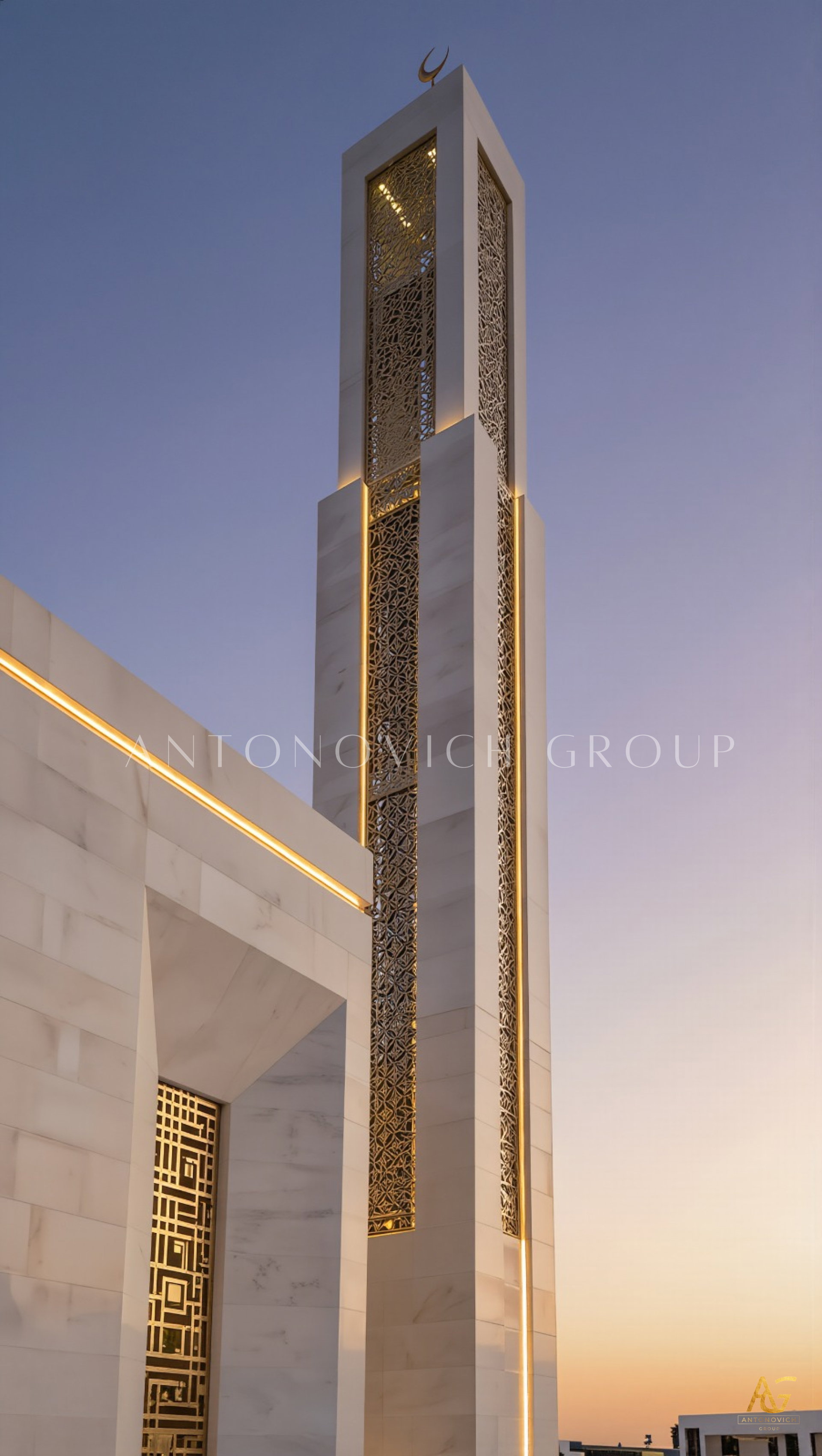
Illuminated Outlines, Cubic Restraint, and the Quiet Power of a Single Inscribed Word
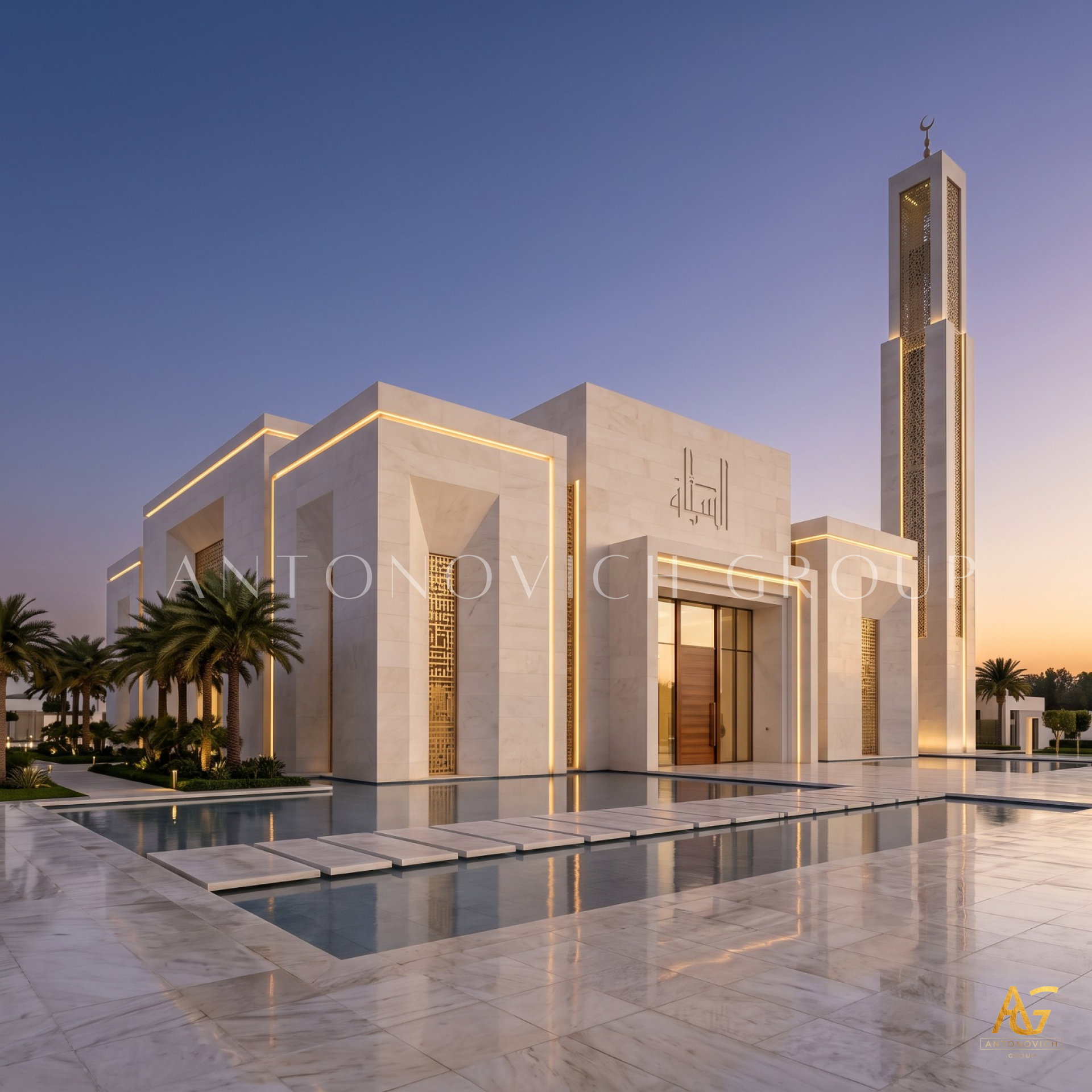
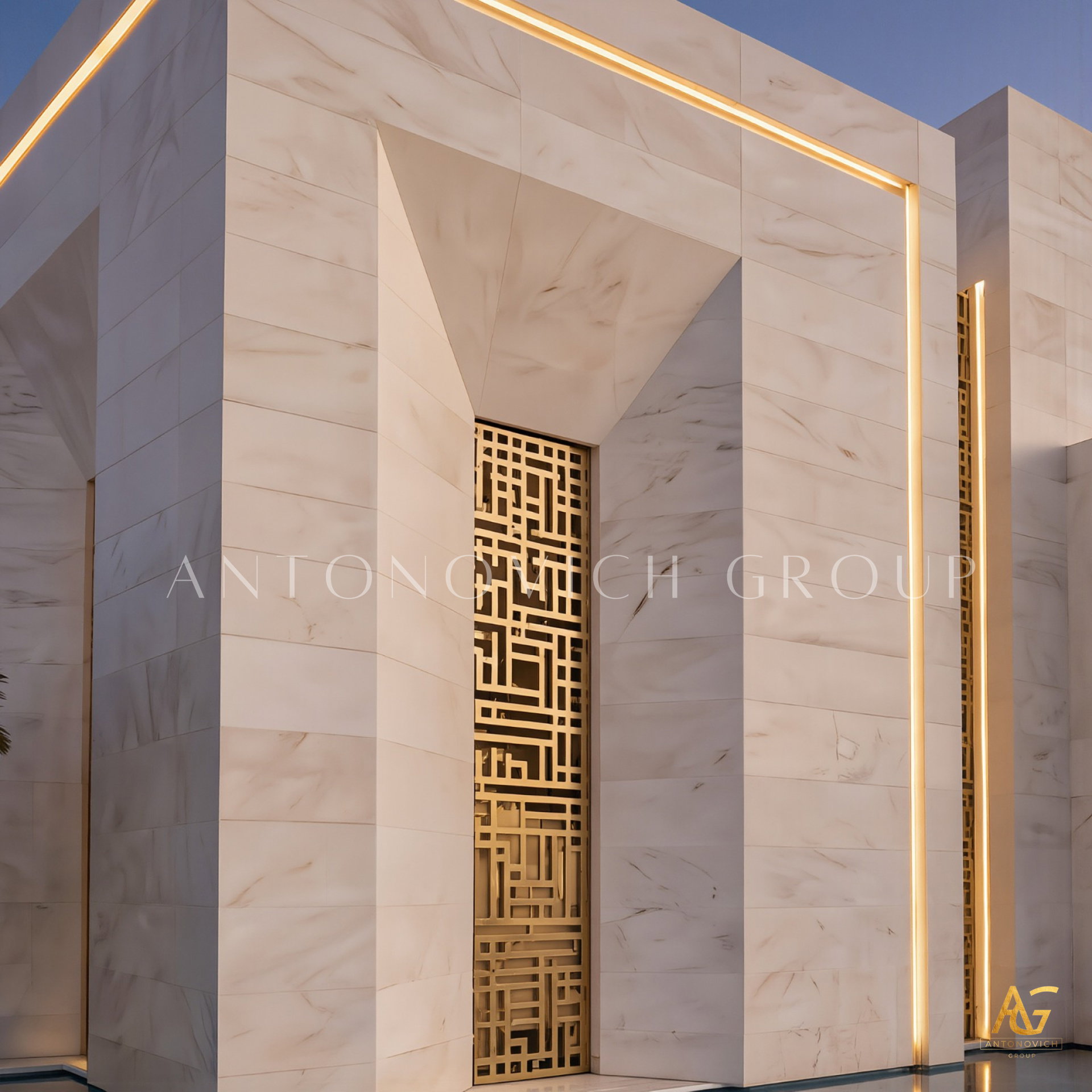
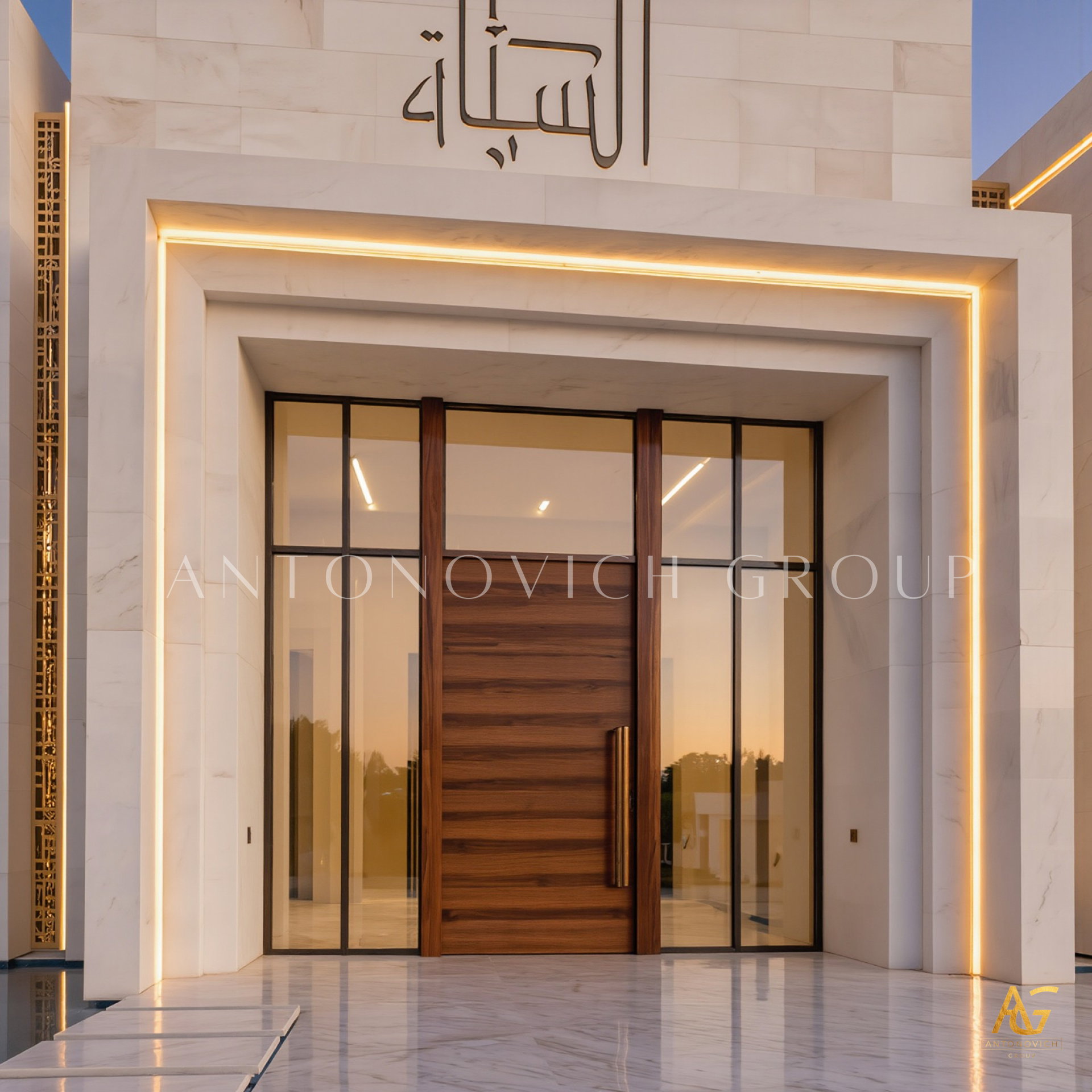
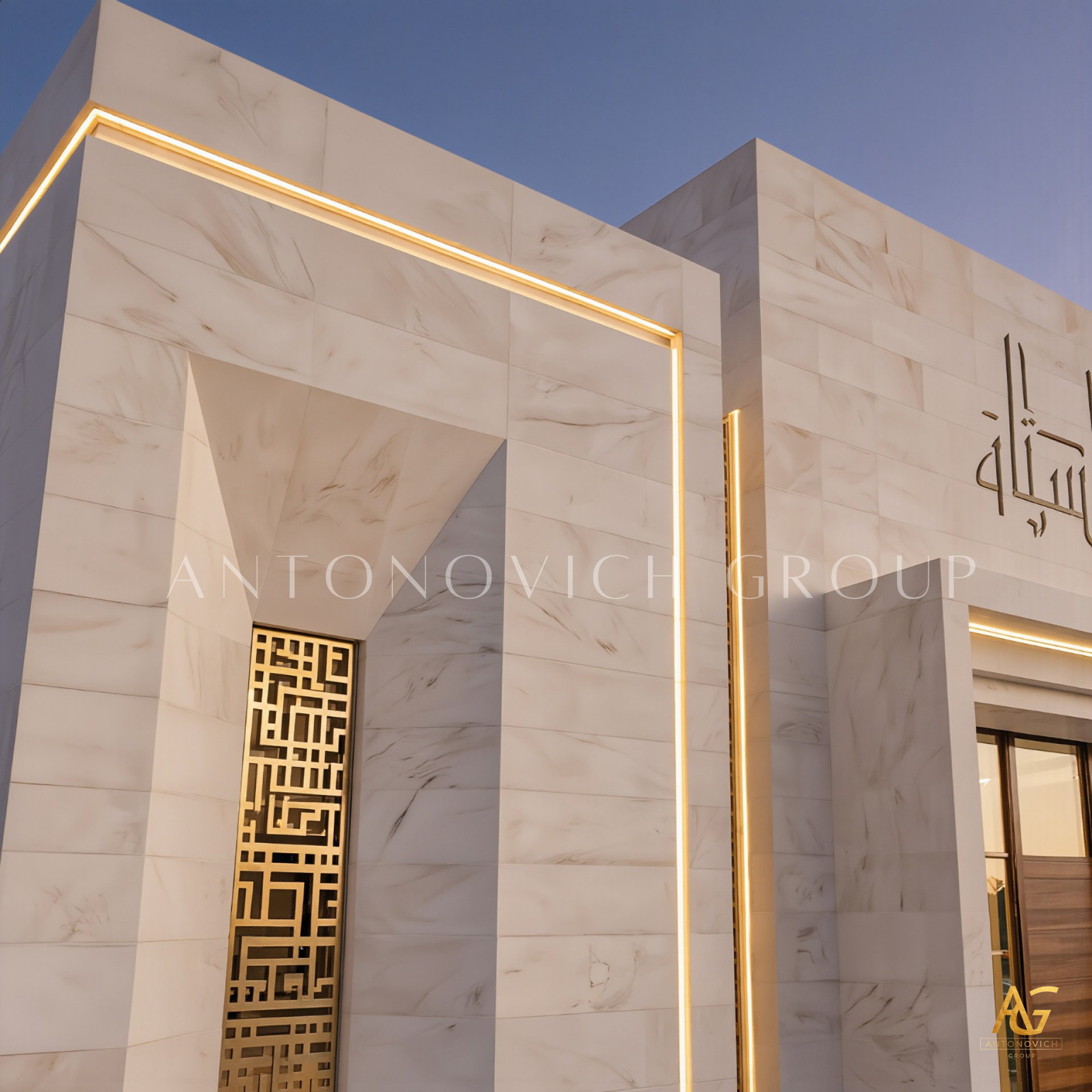
Not every meaningful mosque needs to announce itself as a landmark. Some of the most successful examples of modern mosque architecture are designed to serve a neighborhood, not a skyline — smaller in scale, closer to the community, and quieter in ambition. The concept featured above belongs to exactly this category. A composition of simple cubic volumes, finished in pale stone, is traced along every edge with thin lines of warm gold light — as though the building had been sketched directly onto the dusk sky. A single word of Arabic calligraphy marks the entrance. A slender minaret rises behind it. This is Antonovich Group working at an intimate, residential scale, and the restraint on display here is every bit as considered as their most monumental civic work.
The Outline: A Building Defined by Its Edges
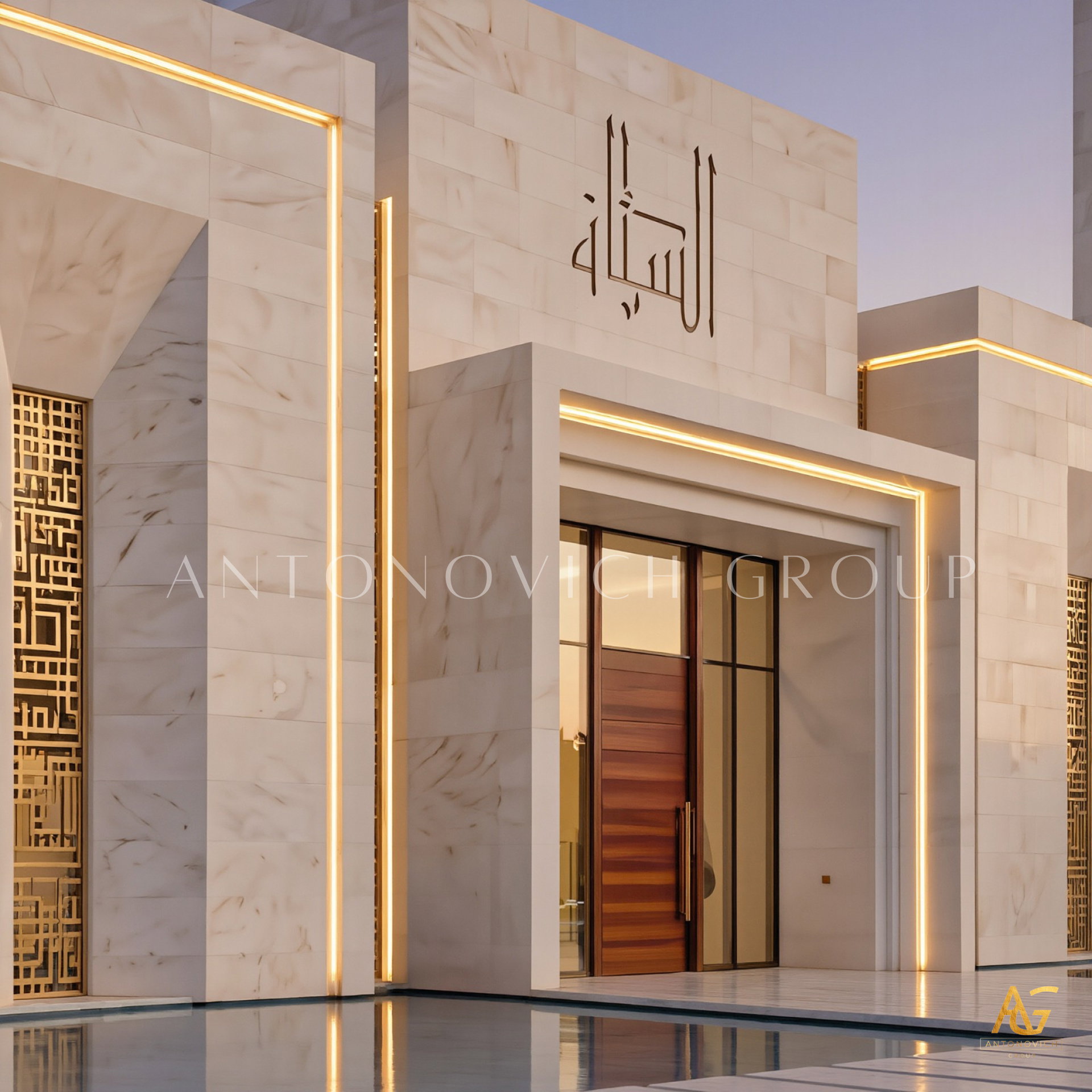
Rather than relying on ornament, texture, or complex massing, this design's primary visual language comes from something remarkably simple — thin strips of warm light tracing the outer edges of each cubic volume, as though the building's geometry had been drawn directly in the air. The effect recalls architectural line drawings brought to physical form, where structure is communicated not through mass, but through outline.
This treatment reflects Antonovich Group's command of minimalist architectural lighting design, using illumination as the primary tool for defining form — proof that a building doesn't need elaborate detailing to feel precisely, confidently composed.
The Word: One Inscription, Fully Trusted
Above the entrance, a single word of Arabic calligraphy is carved directly into the stone facade — restrained, centered, and entirely alone on an otherwise unadorned wall plane. Where many of Antonovich Group's larger civic mosque concepts employ dense, sweeping calligraphic bands, this design places its full trust in a single inscribed word to carry the building's spiritual identity.
This approach to restrained Islamic calligraphic design demonstrates a different kind of confidence — the understanding that meaning doesn't require volume to be felt, and that a single well-placed inscription can hold as much weight as an entire facade of script.
The Blocks: Geometry Without Excess
The mosque's main structure is composed of several simple rectilinear volumes, staggered slightly in height and depth, their surfaces left largely unornamented aside from narrow vertical perforated screens set into select recesses. This use of cubic minimalist mosque architecture reflects a broader design philosophy increasingly present in contemporary residential and community religious buildings — favoring geometric clarity over decorative complexity, particularly in settings where the mosque must sit comfortably alongside neighboring homes rather than dominate a civic plaza.
The Tower: A Single Vertical Landmark
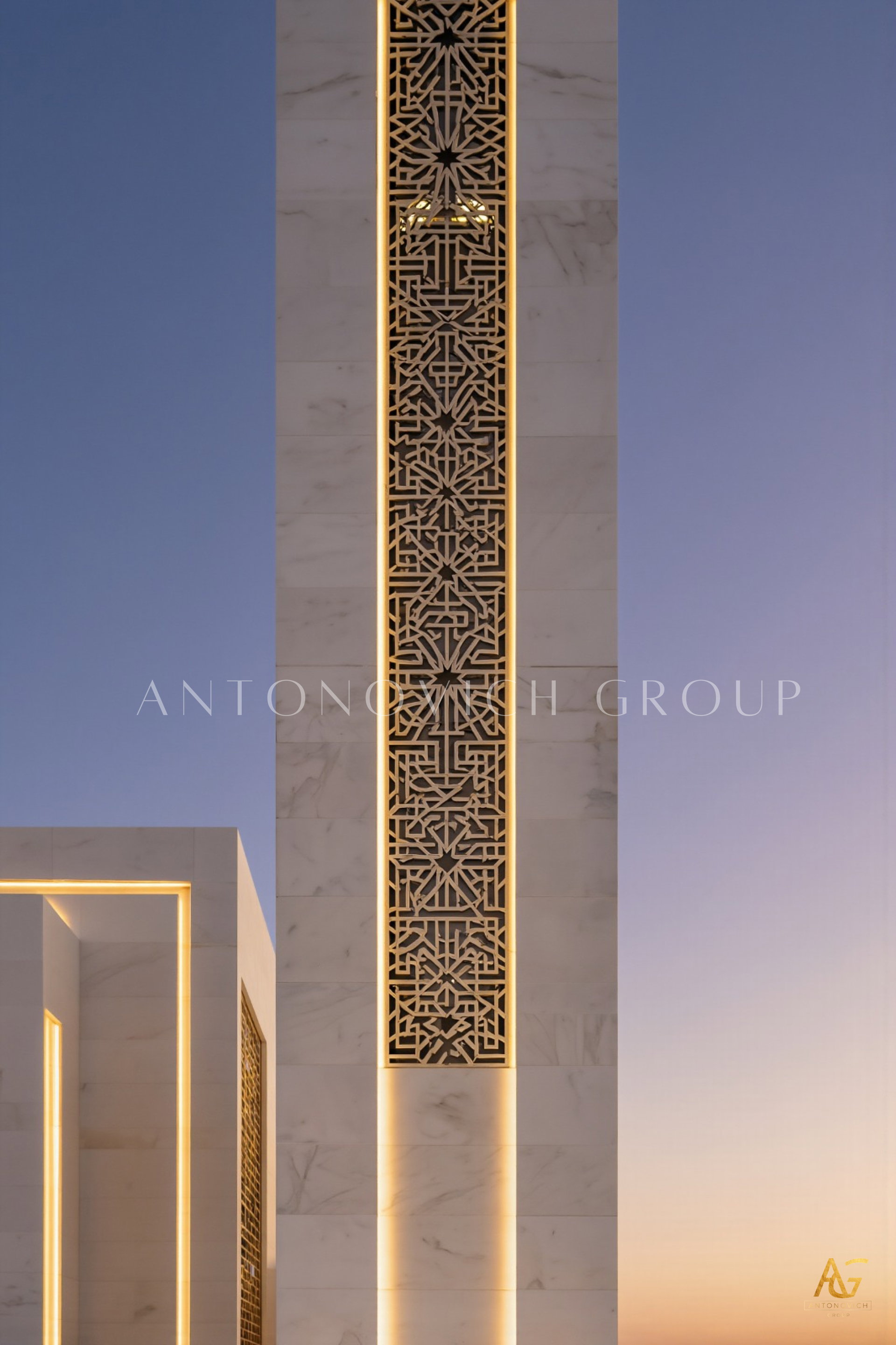
Set slightly apart from the main volume, a tall, slender minaret rises in matching pale stone, its upper section wrapped in fine golden perforated screening that glows warmly at dusk, crowned with a simple crescent finial. Unlike the elaborate, multi-part minarets found in Antonovich Group's larger landmark concepts, this tower remains deliberately singular and understated — enough to mark the building's presence within its neighborhood, without competing for grandeur.
This treatment of residential-scale minaret design reflects an important distinction in mosque architecture: the recognition that a community mosque's minaret serves primarily as local wayfinding and quiet symbolic presence, not as a monumental civic gesture.
The Crossing: A Path Across Still Water
Before the entrance, a shallow reflecting pool is crossed by a simple line of square stepping stones, guiding visitors directly toward the illuminated doorway. This modest water feature performs the same symbolic function found throughout Antonovich Group's grander projects — creating a moment of pause and transition before arrival — but at a scale appropriate to its intimate, neighborhood setting.
This use of community-scaled reflective landscape design shows Antonovich Group's range: the same design instincts that inform sweeping civic reflecting pools apply equally well when scaled down to serve a quieter, more localized threshold experience.
The Neighborhood: Architecture in Context
Visible just beyond the palm trees and garden landscaping, low residential structures frame the mosque's setting, reinforcing that this is a building designed to belong within its community rather than rise above it. This contextual sensitivity reflects Antonovich Group's broader expertise in community-integrated religious architecture — recognizing that not every mosque commission calls for landmark ambition, and that some of the most successful sacred spaces are the ones that feel like a natural extension of the neighborhood they serve.
What This Concept Reveals About Antonovich Group's Range
This design demonstrates a capability that distinguishes Antonovich Group from firms focused solely on monumental statement architecture — the ability to apply the same design discipline, material sensitivity, and cultural understanding to a smaller, more intimate community mosque. Their process for this scale of project typically includes:
- Illuminated outline planning, using light rather than mass or ornament to define architectural form
- Restrained calligraphic placement, selecting a single meaningful inscription rather than distributing decoration broadly
- Contextual massing studies, ensuring the building's scale relates comfortably to its surrounding residential setting
- Singular landmark minaret design, providing local wayfinding presence without civic-scale grandeur
- Modest threshold water features, creating a meaningful sense of arrival appropriate to a neighborhood mosque's daily rhythm
Quiet Confidence at Every Scale
Not every mosque needs to compete with a skyline, and not every design statement requires ornamental density to be meaningful. Through concepts like the one featured here, Antonovich Group demonstrates that modern mosque architecture can be just as thoughtfully resolved at neighborhood scale as it is in the most ambitious civic landmarks — proof that restraint, precision, and a single well-placed line of light can carry genuine architectural weight.
More projects
Any questions?
We will call you back!
We will call you back!
Enter your contact details and our manager will contact you.
Latest Posts

17.10.26
Premium Wall Panels and Finest Lighting Solutions | Address Dubai Opera Residences
Redefining Modern Luxury Apartment Interiors in Downtown Dubai In Dubai’s prestigious residential landscape, luxury apartment interior design is defined by the t...
Read more
Read more

16.10.26
Bespoke Joinery at Address Dubai Opera Residences, Dubai
Bespoke Joinery at Address Dubai Opera Residences Bespoke joinery helps make an apartment feel complete. At Address Dubai Opera Residences in Downtown Dubai, cus...
Read more
Read more

16.10.26
Apartment Renovation and Interior Design at Address Dubai Opera Residences
A successful apartment renovation brings together thoughtful interior design, quality materials and precise execution. At Address Dubai Opera Residences, Antonov...
Read more
Read more

21.09.26
Oceanfront Luxury Residences at Serenia Living Dubai
Bespoke Luxury Apartment Interior Design, Fit-Out, Renovation & Furniture Production by Antonovich Group Serenia Living Dubai represents a distinctive approach t...
Read more
Read more

18.09.26
The Art of Refined Living at St. Regis Dubai
Luxury Apartment Renovation & Bespoke Furnishing by Antonovich Group In Dubai, a luxury residence is more than a place to live. It is an expression of lifestyle,...
Read more
Read more

18.09.26
Modern Luxury Apartment Interior Design & Fit-Out by Antonovich Group
A Bespoke Two-Bedroom Residence at Stella Maris, Dubai Marina, Framed by Bluewaters Island, Marina and JBR Dubai’s waterfront residences demand an interior that...
Read more
Read more

01.09.26
How to Choose the Best Interior Design Company in Doha?
A Complete Guide to Creating a Luxurious Bedroom Interior with Antonovich Group Choosing the best interior design company in Doha is an important decision for ho...
Read more
Read more

29.08.26
Palm Jebel Ali Villa Architecture & Landscape Design
Palm Jebel Ali Villa Architecture and Landscape Design Palm Jebel Ali is becoming one of Dubai’s most prestigious destinations for luxury waterfront living. Its...
Read more
Read more
YouTube Shorts
Recent short videos from Antonovich Group projects, studio work and luxury interiors.
Latest Videos
DOWNTOWN DUBAI APARTMENT | MODERN LUXURY, THOUGHTFULLY EXECUTED

Antonovich Group | A Global Portfolio of Luxury Interiors
The Future of Luxury Villas | Modern Exterior Architecture by Antonovich Group
Luxury Classical Villa Design | Timeless Palace Exterior Architecture | Riyadh, Qatar & UAE
Luxury Majlis Interior Design Saudi Arabia | Royal Majlis by Antonovich Group
Zabeel Saray Villa | A Luxury Interior Design Masterpiece by Antonovich Group
Luxury Villa in Palm Jumeirah Dubai | Interior Renovation & Bespoke Furniture
Opera District Transformation Before & After| Dubai’s #1 Luxury Apartment Renovation Company