
Updated at: 07.08.26

Light and Shadow: A New Language of Contrast in Mosque Architecture
What Happens When Light Meets Shadow in Sacred Architecture?
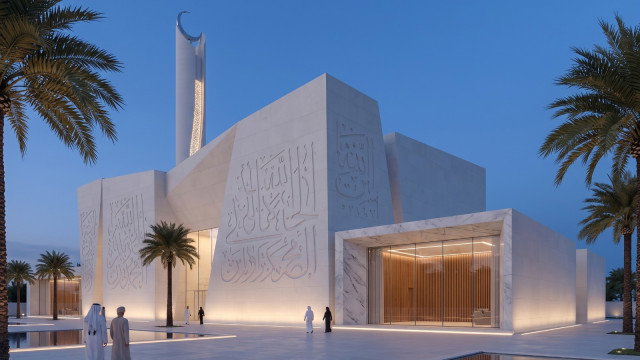
Most mosque architecture builds its identity through a single dominant material — white marble, warm sandstone, gleaming metal. The concept featured above takes a more editorial approach, built instead on the tension between opposites: a pale marble volume outlined in gold like a framed portrait, set directly beside a darkened glass-and-metal wall bearing its own dense calligraphic pattern, while in the distance, a minaret rises to an unexpected conclusion — a small glass capsule catching the last light of dusk. This is Antonovich Group working through contrast rather than consistency, and the result is a mosque that reads less like a single gesture and more like a carefully composed dialogue.The Frame: A Roofline Outlined Like a Drawing
The building's primary cubic volume is defined not by its mass alone, but by a continuous line of warm gold light tracing precisely along its roof edges — as though the entire structure had been outlined, mitred at each corner with the same precision found in a hand-drawn architectural sketch. This treatment reflects Antonovich Group's command of precision edge-lighting design, using illumination not merely to brighten a facade, but to formally define and frame the building's geometry itself.
The effect lends the mosque a sense of graphic clarity — a structure that feels drawn as much as built, its proportions made legible even from a distance through nothing more than a thin, continuous line of light.
The Threshold: A Pointed Arch Flanked by Woven Script
At the building's entrance, a traditional pointed archway is framed on either side by tall panels of dense Kufic calligraphy, illuminated softly from within their carved recesses. This treatment of Kufic calligraphic entrance framing anchors the composition's most contemporary elements — the sharp cubic massing, the graphic roofline — within an unmistakably traditional threshold gesture, ensuring the building's overall modern language never loses its connection to established Islamic architectural vocabulary.
The Contrast: Where Marble Gives Way to Glass and Shadow
Set apart from the mosque's pale marble volume, a secondary structure finished in dark glass and black metal introduces a striking material contrast — its surface patterned with an intricate calligraphic screen rendered not in warm stone, but in cool, shadowed metalwork. This is perhaps the concept's boldest gesture: allowing a portion of the building to recede into darkness and reflection, rather than maintaining the luminous white palette found throughout the rest of the composition.
This use of contrasting material duality in mosque design demonstrates real design confidence — the willingness to let part of a sacred building read as quiet and introspective, a deliberate counterpoint to the bright, gold-framed volume beside it.
The Ascent: A Minaret That Ends in Glass
Rising independently near the water's edge, the mosque's minaret follows a familiar tapering, banded form for most of its height — until its uppermost section suddenly shifts material entirely, culminating in a small glazed capsule that catches and holds the day's remaining light like a lantern set atop stone. This unexpected conclusion reflects Antonovich Group's willingness to introduce a genuine moment of surprise within an otherwise classically proportioned tower.
This treatment of glass-crowned minaret design transforms the minaret's traditional finial into something closer to an observatory or beacon, suggesting a contemporary reinterpretation of the tower's historic role as a point of illumination and calling.
The Passage: Pergolas Tracing the Water's Edge
Along the plaza's perimeter, a series of simple white pergolas extends toward the reflecting pool, their clean structural lines echoing the mosque's own edge-lit geometry while providing shaded passage for visitors moving between garden and entrance. This use of minimalist pergola landscape design reinforces the composition's overall graphic clarity, treating even secondary structures as extensions of the same disciplined formal language found throughout the main building.
The Mirror: Gold-Veined Water Framing the Composition
Wrapping around much of the plaza, a still reflecting pool — its stone border inlaid with fine gold jointing lines — doubles the mosque's illuminated edges and darkened glass wall alike, extending the building's contrast-driven composition fully into the landscape. This use of gold-inlaid reflective plaza design ensures that even the ground plane participates in the project's broader visual language of precision and framing.
Antonovich Group's Command of Deliberate Contrast
This concept reflects a specific strength within Antonovich Group's practice — the ability to build meaning through material and tonal opposition rather than uniform consistency. Their process for achieving this kind of contrast-driven religious architecture typically includes:
- Precision lighting geometry, using continuous edge-lit lines to define and frame architectural form
- Traditional-contemporary threshold balancing, anchoring modern massing with historically grounded entrance detailing
- Material duality planning, deliberately contrasting luminous stone against darkened glass and metal
- Unexpected structural culmination, introducing calculated surprise within otherwise classically proportioned elements like the minaret
- Landscape material continuity, extending a building's material and lighting language fully into its surrounding plaza
Why Contrast Deserves a Place in Mosque Architecture
It would be simpler, in many ways, to design a mosque built entirely around a single unifying material and mood. This concept argues for something more demanding: that meaning can emerge just as powerfully from contrast — light against shadow, stone against glass, tradition against surprise. For architects, developers, and communities seeking a mosque design firm willing to work in this more editorial register, Antonovich Group's approach here demonstrates genuine command of tonal complexity, without ever losing the coherence required of sacred space.
Closing Thought: A Building That Argues With Itself, Gracefully
Not every mosque needs to resolve into a single, uncomplicated statement. Through concepts like the one featured here, Antonovich Group demonstrates that modern mosque architecture can hold real tension within its own composition — light framed against shadow, tradition set beside surprise — and still arrive at something that feels entirely, confidently whole.
More projects
Any questions?
We will call you back!
We will call you back!
Enter your contact details and our manager will contact you.
Latest Posts

17.10.26
Premium Wall Panels and Finest Lighting Solutions | Address Dubai Opera Residences
Redefining Modern Luxury Apartment Interiors in Downtown Dubai In Dubai’s prestigious residential landscape, luxury apartment interior design is defined by the t...
Read more
Read more

16.10.26
Bespoke Joinery at Address Dubai Opera Residences, Dubai
Bespoke Joinery at Address Dubai Opera Residences Bespoke joinery helps make an apartment feel complete. At Address Dubai Opera Residences in Downtown Dubai, cus...
Read more
Read more

16.10.26
Apartment Renovation and Interior Design at Address Dubai Opera Residences
A successful apartment renovation brings together thoughtful interior design, quality materials and precise execution. At Address Dubai Opera Residences, Antonov...
Read more
Read more

21.09.26
Oceanfront Luxury Residences at Serenia Living Dubai
Bespoke Luxury Apartment Interior Design, Fit-Out, Renovation & Furniture Production by Antonovich Group Serenia Living Dubai represents a distinctive approach t...
Read more
Read more

18.09.26
The Art of Refined Living at St. Regis Dubai
Luxury Apartment Renovation & Bespoke Furnishing by Antonovich Group In Dubai, a luxury residence is more than a place to live. It is an expression of lifestyle,...
Read more
Read more

18.09.26
Modern Luxury Apartment Interior Design & Fit-Out by Antonovich Group
A Bespoke Two-Bedroom Residence at Stella Maris, Dubai Marina, Framed by Bluewaters Island, Marina and JBR Dubai’s waterfront residences demand an interior that...
Read more
Read more

01.09.26
How to Choose the Best Interior Design Company in Doha?
A Complete Guide to Creating a Luxurious Bedroom Interior with Antonovich Group Choosing the best interior design company in Doha is an important decision for ho...
Read more
Read more

29.08.26
Palm Jebel Ali Villa Architecture & Landscape Design
Palm Jebel Ali Villa Architecture and Landscape Design Palm Jebel Ali is becoming one of Dubai’s most prestigious destinations for luxury waterfront living. Its...
Read more
Read more
YouTube Shorts
Recent short videos from Antonovich Group projects, studio work and luxury interiors.
Latest Videos
DOWNTOWN DUBAI APARTMENT | MODERN LUXURY, THOUGHTFULLY EXECUTED
Antonovich Group | A Global Portfolio of Luxury Interiors
The Future of Luxury Villas | Modern Exterior Architecture by Antonovich Group
Luxury Classical Villa Design | Timeless Palace Exterior Architecture | Riyadh, Qatar & UAE
Luxury Majlis Interior Design Saudi Arabia | Royal Majlis by Antonovich Group
Zabeel Saray Villa | A Luxury Interior Design Masterpiece by Antonovich Group
Luxury Villa in Palm Jumeirah Dubai | Interior Renovation & Bespoke Furniture
Opera District Transformation Before & After| Dubai’s #1 Luxury Apartment Renovation Company