
Updated at: 08.08.26

A Crystal in the Desert: Antonovich Group's Mineral Vision for Mosque Architecture
Antonovich Group's Crystalline Mosque Architecture
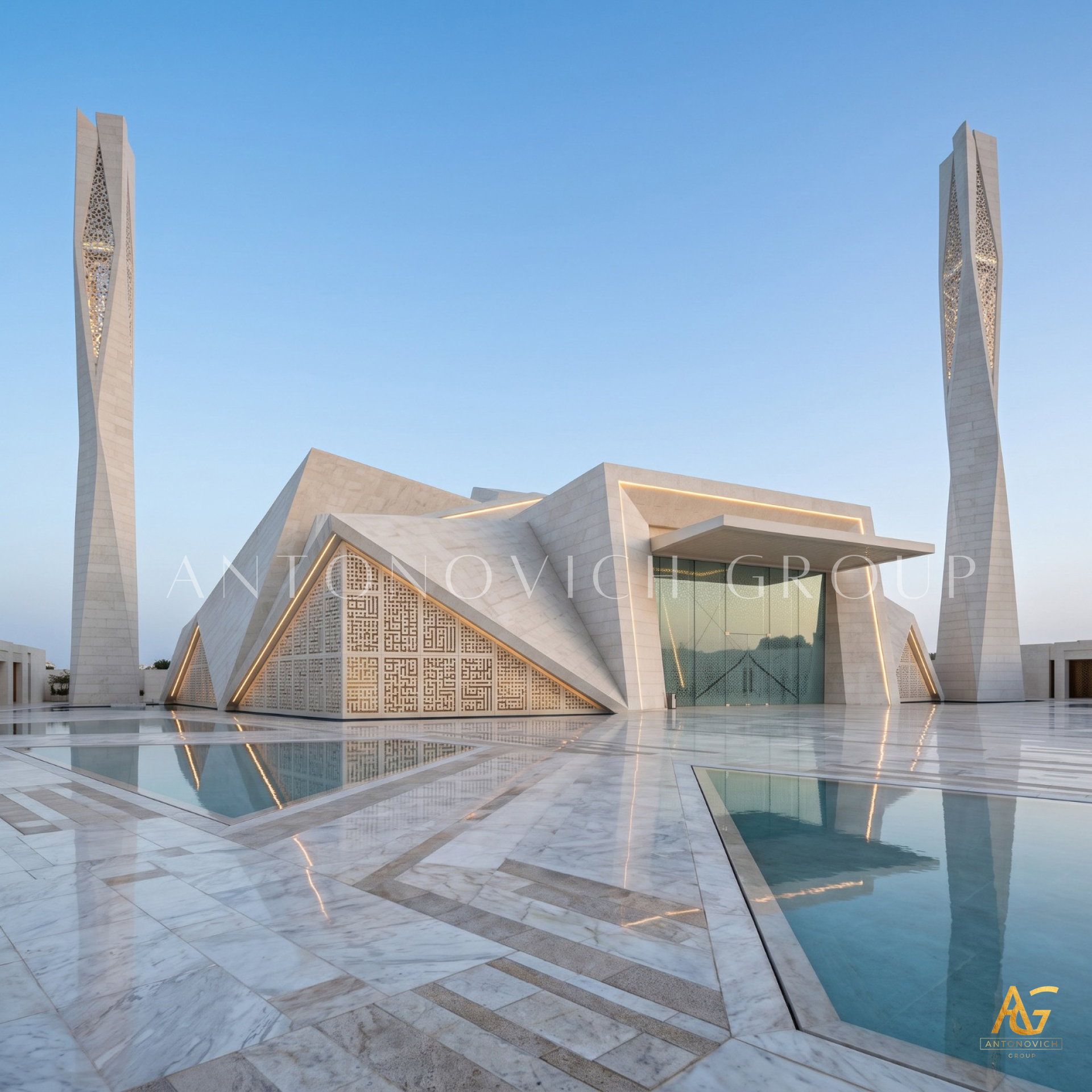
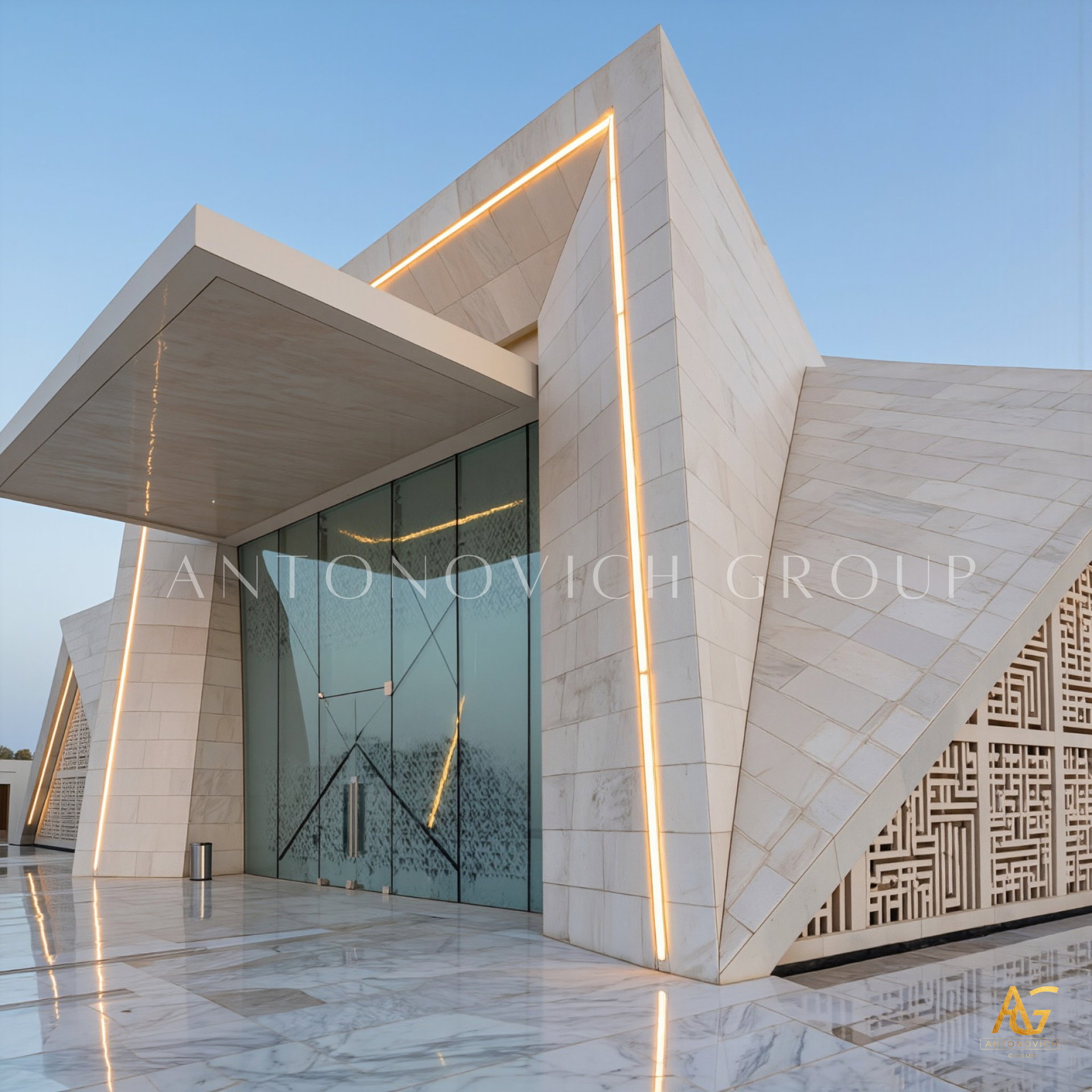
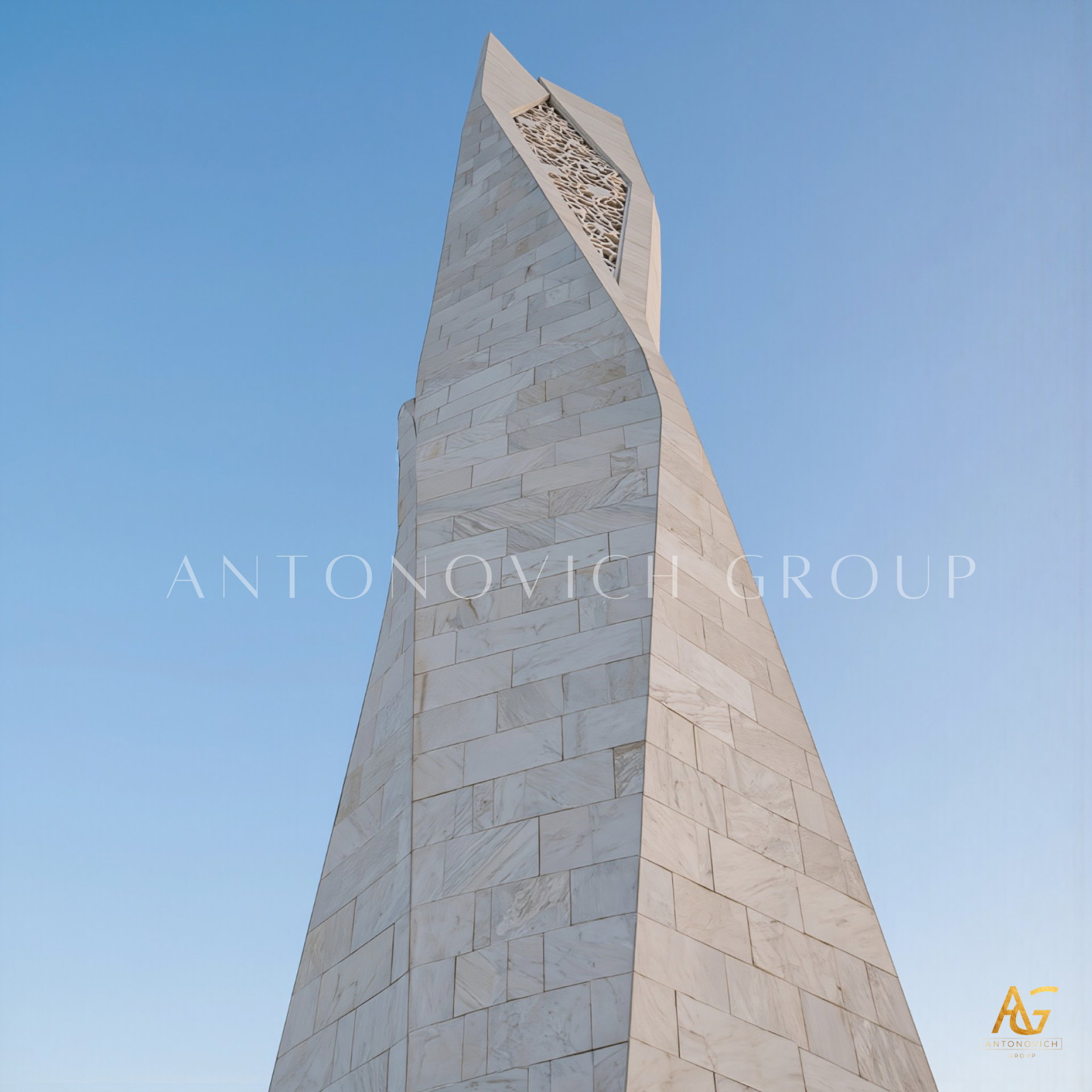
Some buildings evoke construction. Others evoke formation — as though they had grown, pressure by pressure, into their final shape rather than been assembled piece by piece. The concept featured above belongs firmly to the second impression. Sharp, faceted planes of pale stone meet at hard angular edges, catching the day's light unevenly across dozens of distinct surfaces, while two towering, gem-cut minarets rise nearby, each pierced by a narrow vein of illuminated void running through their twisting form. This is Antonovich Group's most mineral-inspired composition — a mosque that reads less like architecture in the conventional sense, and more like a crystal formation given devotional purpose.
The Formation: A Mass Shaped by Pressure
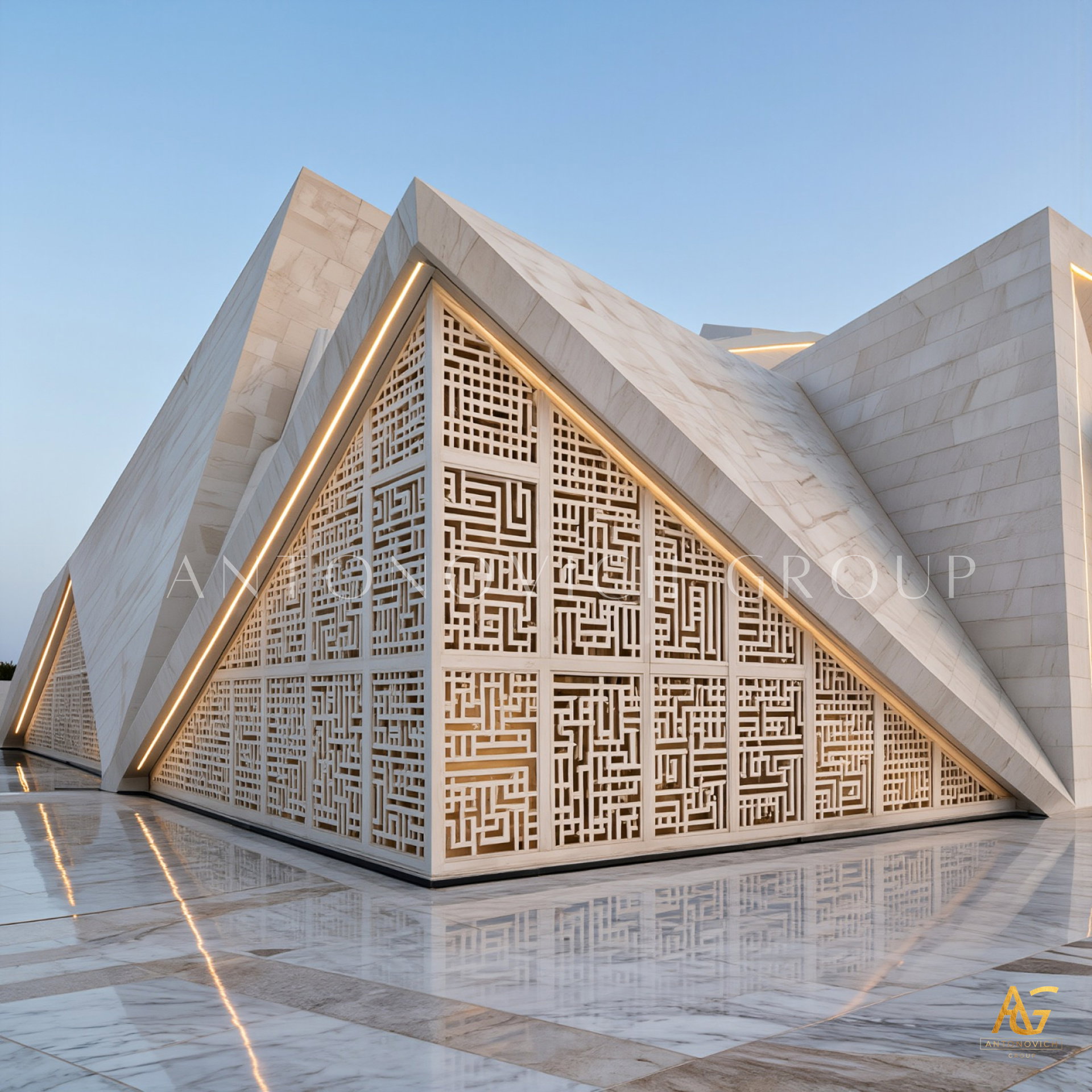
The building's central volume doesn't announce itself through a single dominant silhouette. Instead, it presents as a cluster of angular planes meeting at irregular, faceted junctions — the kind of geometry more commonly associated with natural crystal growth than deliberate architectural design. Each surface catches ambient light at a slightly different angle, producing a shifting patchwork of tone across the structure as the sun moves through the sky.
This treatment reflects Antonovich Group's exploration of crystalline mosque architecture, a formal language that deliberately avoids smooth, continuous curvature or clean orthogonal geometry in favor of something that feels closer to a mineral specimen — irregular, multifaceted, and seemingly shaped by forces greater than a single design decision.
The Vein: Light Running Through Solid Stone
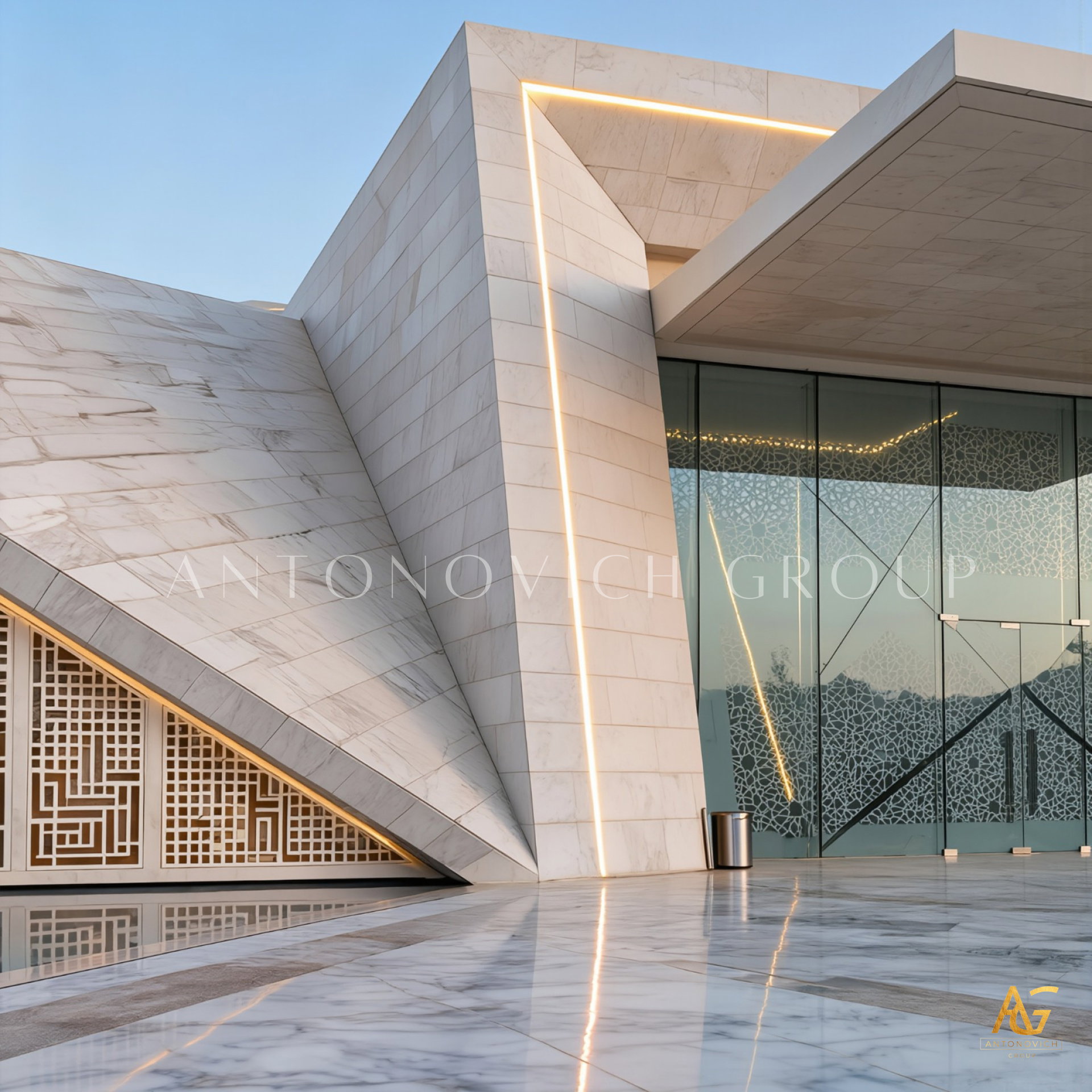
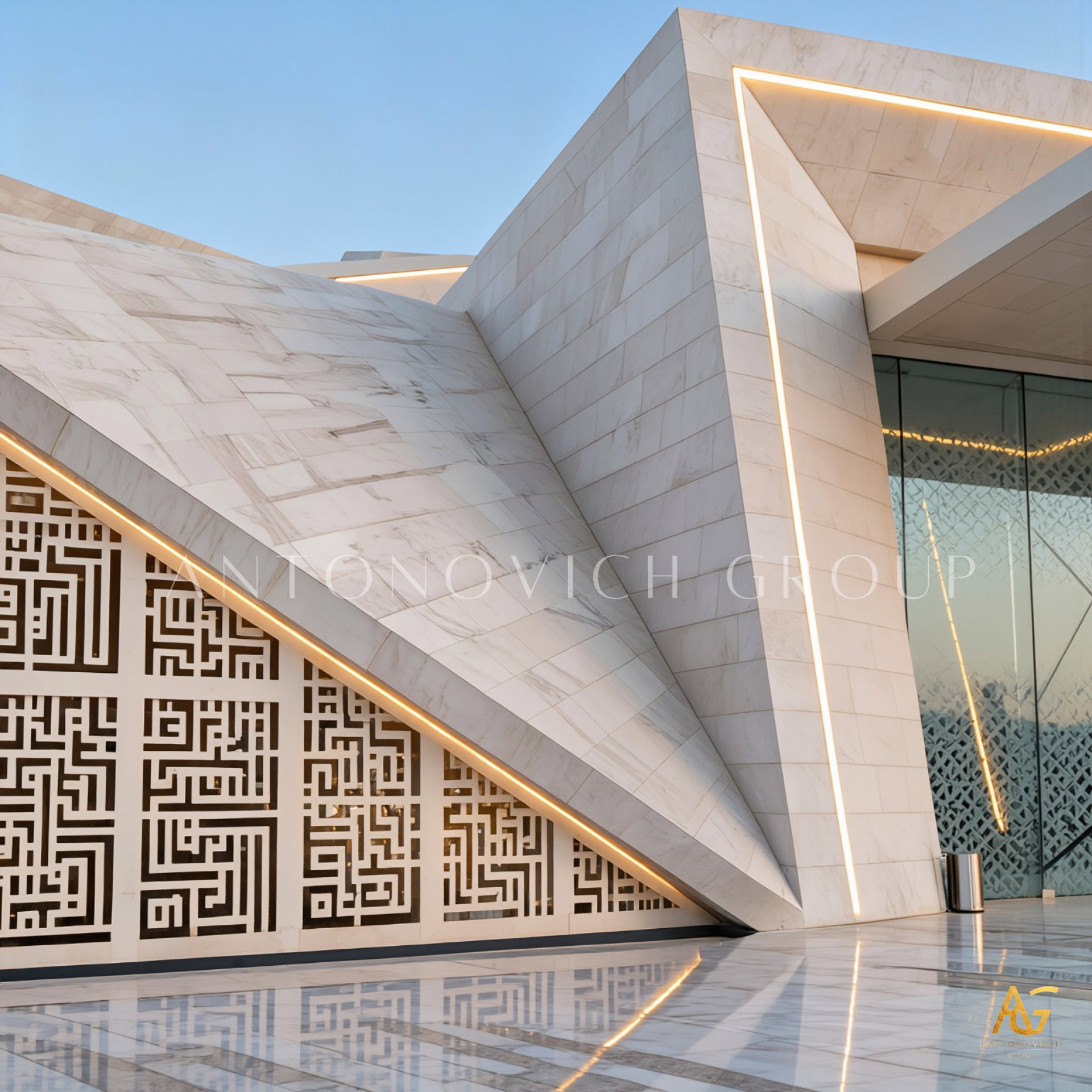
Along the building's most dramatic angled surface, a broad triangular section gives way to a dense, glowing lattice of Kufic calligraphy, light pouring outward as though the stone itself had cracked open to reveal an illuminated seam running beneath its surface. Rather than reading as applied ornament, the effect suggests something more geological — a vein of light discovered within solid rock, rather than a decorative pattern layered onto a wall.
This treatment of illuminated calligraphic vein design reflects Antonovich Group's ability to make ornament feel structurally inevitable rather than additive, as though the building's most sacred inscription had always existed within the stone, simply waiting to be exposed.
The Facets: A Surface That Refuses to Repeat
Examining the building's broader stone surface reveals no obvious repeating module or standardized panel — each facet meets its neighbor at a distinct angle, producing a composition that feels genuinely irregular rather than patterned. This commitment to non-repeating faceted surface design requires exceptional precision in both digital modeling and physical fabrication, ensuring that what reads as organic irregularity from a distance remains structurally sound and buildable at full architectural scale.
The Threshold: Where Crystal Gives Way to Glass
At the building's entrance, the faceted stone parts to reveal a fully glazed opening, overlaid with a fine geometric mashrabiya pattern and sheltered beneath a broad, softly lit cantilevered canopy. This moment functions as the composition's clearest transition — solid mineral form yielding to transparency, echoing the way a cut gemstone might reveal an internal facet of clarity at its center.
This use of contemporary glazed threshold design demonstrates Antonovich Group's understanding that even the most sculptural, mineral-inspired exterior still requires a legible, welcoming point of human entry.
The Spires: Crystals Grown Tall and Twisting
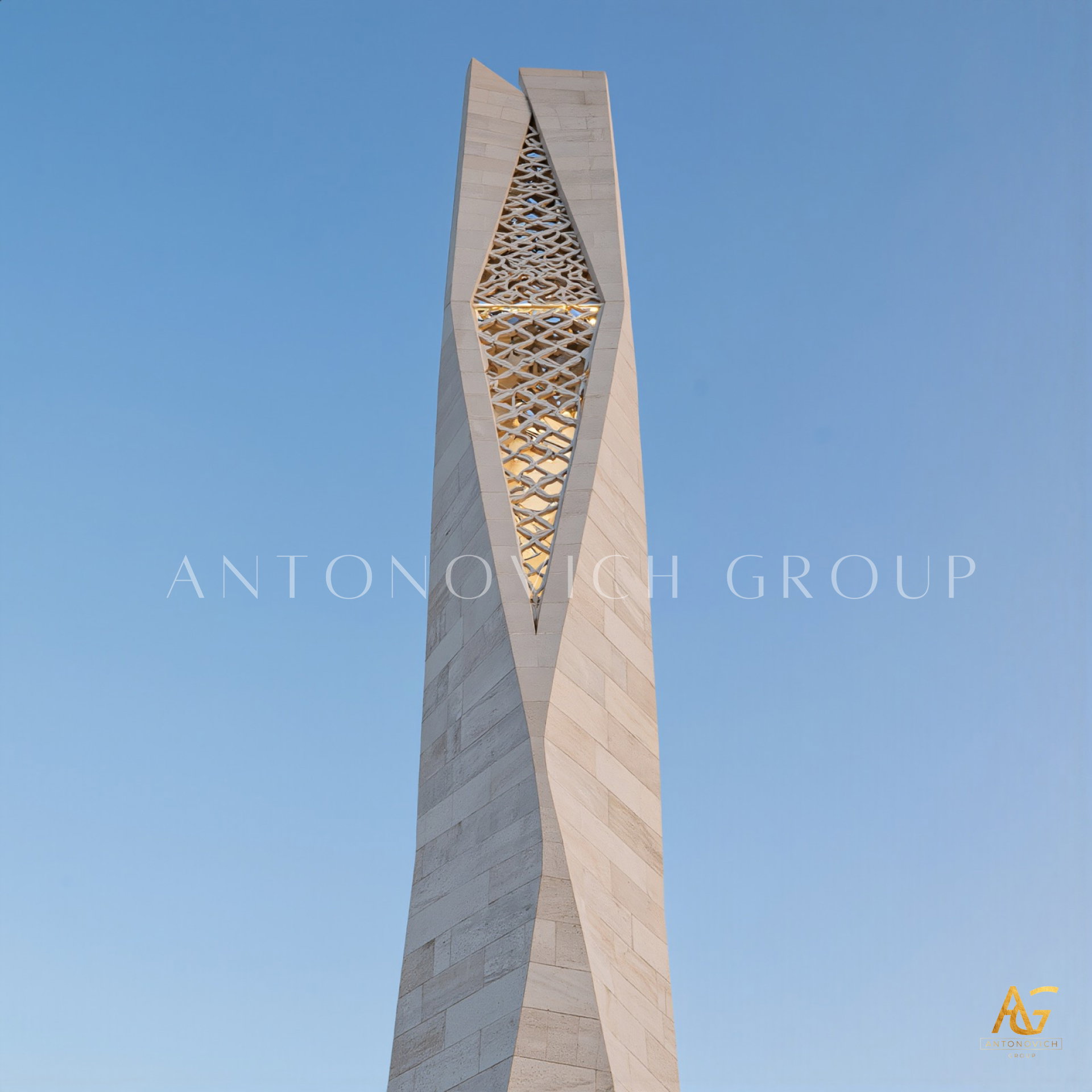
Rising independently on either side of the plaza, the mosque's two minarets extend the building's crystalline logic to its most extreme vertical expression — narrow, twisting forms pierced by elongated, eye-shaped voids that spiral gradually along their height, each opening glowing from illuminated surfaces within. They read less as constructed towers and more as naturally formed crystal points, elongated and polished into their final sculptural state.
This approach to crystalline spire minaret design stands among Antonovich Group's most formally daring minaret treatments, using absence and void as much as solid material to define the towers' final silhouette.
The Bed: A Plaza That Continues the Mineral Logic
Beneath the building, the surrounding marble plaza carries forward the same faceted, irregular geometry through inlaid stone seams and contrasting tonal bands, while two symmetrical reflecting pools flank the composition, doubling its jagged silhouette across still water. This treatment of geometric mineral-inspired plaza design ensures the ground itself feels like part of the same formation as the building rising from it — a continuous mineral landscape rather than a neutral paved surface beneath a separate structure.
Antonovich Group's Command of Formational Design Logic
This concept reflects a distinctive capability within Antonovich Group's broader practice — the ability to make constructed architecture feel as though it emerged from natural process rather than deliberate assembly. Their approach to this kind of formational architectural design typically includes:
- Irregular facet modeling, developing non-repeating angular surfaces that remain structurally coherent at scale
- Structural-calligraphic integration, treating illuminated inscription as an inherent feature of the material rather than applied decoration
- Void-based sculptural engineering, using carefully placed openings to define crystalline minaret forms
- Threshold contrast planning, transitioning convincingly between solid mineral massing and glazed transparency
- Continuous ground-plane geometry, extending a building's formal language fully into its surrounding landscape
Describing architecture through the language of geology rather than construction isn't simply a poetic device — it points to something genuinely ambitious in this concept's execution: a building designed to feel inevitable, as though its irregular, faceted form were the natural result of pressure and time rather than deliberate human decision. For architects, developers, and communities exploring what contemporary Islamic architecture can become when drawing inspiration from natural formation rather than architectural convention, Antonovich Group's approach here offers a genuinely distinctive model.
Stone That Remembers How to Form
A mosque built to resemble a crystal doesn't ask to be understood as something constructed — it asks to be understood as something discovered, shaped by forces larger and older than any single design decision. Through concepts like the one featured here, Antonovich Group continues to expand the material imagination of modern mosque architecture, proving that even the most deliberately engineered building can be made to feel as though it simply grew into being.
More projects
Any questions?
We will call you back!
We will call you back!
Enter your contact details and our manager will contact you.
Latest Posts

17.10.26
Premium Wall Panels and Finest Lighting Solutions | Address Dubai Opera Residences
Redefining Modern Luxury Apartment Interiors in Downtown Dubai In Dubai’s prestigious residential landscape, luxury apartment interior design is defined by the t...
Read more
Read more

16.10.26
Bespoke Joinery at Address Dubai Opera Residences, Dubai
Bespoke Joinery at Address Dubai Opera Residences Bespoke joinery helps make an apartment feel complete. At Address Dubai Opera Residences in Downtown Dubai, cus...
Read more
Read more

16.10.26
Apartment Renovation and Interior Design at Address Dubai Opera Residences
A successful apartment renovation brings together thoughtful interior design, quality materials and precise execution. At Address Dubai Opera Residences, Antonov...
Read more
Read more

21.09.26
Oceanfront Luxury Residences at Serenia Living Dubai
Bespoke Luxury Apartment Interior Design, Fit-Out, Renovation & Furniture Production by Antonovich Group Serenia Living Dubai represents a distinctive approach t...
Read more
Read more

18.09.26
The Art of Refined Living at St. Regis Dubai
Luxury Apartment Renovation & Bespoke Furnishing by Antonovich Group In Dubai, a luxury residence is more than a place to live. It is an expression of lifestyle,...
Read more
Read more

18.09.26
Modern Luxury Apartment Interior Design & Fit-Out by Antonovich Group
A Bespoke Two-Bedroom Residence at Stella Maris, Dubai Marina, Framed by Bluewaters Island, Marina and JBR Dubai’s waterfront residences demand an interior that...
Read more
Read more

01.09.26
How to Choose the Best Interior Design Company in Doha?
A Complete Guide to Creating a Luxurious Bedroom Interior with Antonovich Group Choosing the best interior design company in Doha is an important decision for ho...
Read more
Read more

29.08.26
Palm Jebel Ali Villa Architecture & Landscape Design
Palm Jebel Ali Villa Architecture and Landscape Design Palm Jebel Ali is becoming one of Dubai’s most prestigious destinations for luxury waterfront living. Its...
Read more
Read more
YouTube Shorts
Recent short videos from Antonovich Group projects, studio work and luxury interiors.
Latest Videos
DOWNTOWN DUBAI APARTMENT | MODERN LUXURY, THOUGHTFULLY EXECUTED
Antonovich Group | A Global Portfolio of Luxury Interiors
The Future of Luxury Villas | Modern Exterior Architecture by Antonovich Group
Luxury Classical Villa Design | Timeless Palace Exterior Architecture | Riyadh, Qatar & UAE
Luxury Majlis Interior Design Saudi Arabia | Royal Majlis by Antonovich Group
Zabeel Saray Villa | A Luxury Interior Design Masterpiece by Antonovich Group
Luxury Villa in Palm Jumeirah Dubai | Interior Renovation & Bespoke Furniture
Opera District Transformation Before & After| Dubai’s #1 Luxury Apartment Renovation Company